
Folks, if you've been around real estate investing for more than about ten minutes, you've heard somebody throw around the term "hard money." And usually they say it like it's some kind of secret handshake. It isn't. It's just a loan. A short, expensive, fast loan that a certain kind of lender makes against a certain kind of deal. That's the whole thing.
I've watched a lot of new folks tie themselves in knots over this, so let me put it in plain English the way I'd explain it to somebody sitting across the table from me. No jargon, no mystery. Just how it works, what it costs in real dollars, and when it actually makes sense to use it.
What a hard money loan actually is
A hard money loan is a short-term loan secured by the property itself. That's the piece most people miss. A bank looks at you: your credit score, your two years of tax returns, your debt-to-income, all of it. A hard money lender looks at the deal. The house is the collateral. If the numbers on the house work, they'll usually lend on it. If you default, they take the house. Simple as that.
Who makes these loans? Not the bank down the street and not your credit union. Hard money comes from private lending companies, small investment groups, and individual folks with capital who'd rather earn a return on a real estate note than leave their money sitting in a savings account. That's why it's faster and looser than a bank. There's no giant institution and no underwriting committee standing between you and the money.
Now here's the tradeoff, and I want to be straight with you about it. That speed and that flexibility cost you. Hard money is the most expensive money in the room. You don't reach for it because it's cheap. You reach for it because it's fast, and because sometimes fast is worth more than cheap.
The numbers, because the numbers are sacred
I'm not going to teach you anything in this business without putting real figures on it, so let's do that.
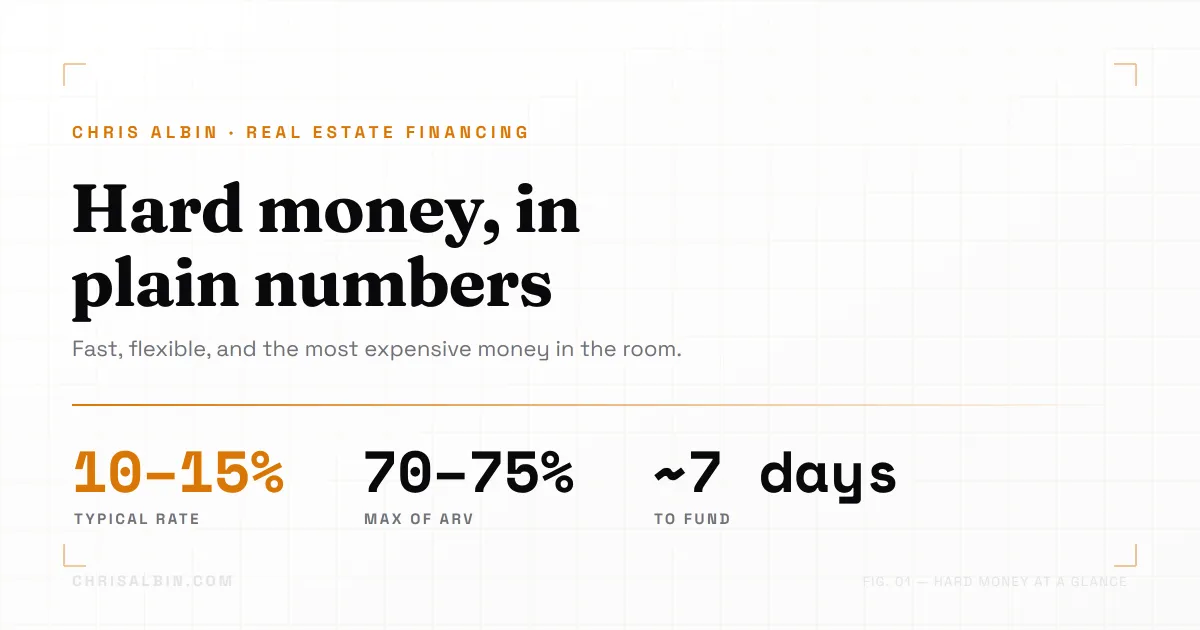
Interest rates on hard money typically run somewhere in the neighborhood of 10 to 15 percent. Compare that to a conventional mortgage and yeah, it'll make your eyes water. On top of the rate, most lenders charge "points" up front, an origination fee, usually a couple points, where one point equals one percent of the loan. So on a $150,000 loan, two points is $3,000 you're paying just to get the money.
Then there's the number that decides whether they'll lend at all. Most hard money lenders won't go above about 70 to 75 percent of the property's after-repair value, the ARV, meaning what the house will be worth once you've fixed it up. Some run their math on loan-to-cost instead, but that 70-to-75-percent ceiling on the finished value is the one to keep in your head. It's the same discipline a good flipper uses on his own money, which is not an accident. The lender is protecting himself the exact way you should be protecting yourself.

And the term is short. We're usually talking six to twelve months, sometimes eighteen. This isn't a thirty-year mortgage you settle into. It's a bridge. You get in, you do the work, you get out, either by selling the house or by refinancing into cheaper long-term financing.
So run the whole picture: high rate, points up front, a hard cap tied to the finished value, and a short clock ticking the entire time. That's hard money. When somebody tells you it's a shortcut to riches, they're selling you something. It's a tool, and like any tool it's wonderful in the right hand and dangerous in the wrong one.
When hard money actually makes sense
Here's where it earns its keep. The whole reason this money exists is speed. A hard money lender can often fund a deal in about a week, sometimes faster, while a conventional mortgage is going to take you thirty to sixty days, and that's if nothing goes sideways in underwriting. In this business, being able to close fast is a real advantage. A motivated seller who needs to be done by the end of the month doesn't care about your pre-approval letter. He cares that you can actually perform.
So hard money fits a specific shape of deal. Fix-and-flips, mostly. You find a beat-up house that nobody with a normal loan can touch, you use hard money to buy it and fund the rehab, you fix it, and you sell it or refinance inside that short window. The high cost of the money gets absorbed by the profit on the flip — if you bought it right in the first place. That "if" is doing a lot of work in that sentence, and I want you to feel the weight of it.
Where it does not make sense is a buy-and-hold you're planning to sit on, or any deal where the margin is thin. If the spread between what you're all-in for and what the house is worth fixed up is skinny, that 12 percent and those points will eat your whole profit and then some. The math has to leave room for the expensive money. If it doesn't, the answer isn't a better lender. The answer is a better deal, or no deal at all. No for now is not no forever.
How I'd think about it as a beginner
If you're just getting started, I'd tell you what I tell everybody: understand the tool before you ever need it, so you're not learning it under pressure with your own money on the line. Hard money is not where most folks should begin, but it belongs in your education from day one, right alongside understanding how much money you actually need to invest in real estate and whether you can invest with little or no money of your own. Those three ideas (hard money, low-money-down, and what it really costs to get in) all live in the same corner of the toolbox.

The mindset that keeps you safe is the same one that keeps a good lender safe: the numbers decide. Not your excitement, not the wholesaler's spreadsheet, not the pretty pictures. You run the ARV honestly, you run the rehab honestly, you leave a real margin, and then you see if the deal can carry expensive money. Most of the time for a beginner, the honest answer is "not yet," and that's fine. Learning to say "not yet" to a bad deal is most of this game. If you want the bigger picture of how a new investor gets going the right way, I laid that out in how to become a real estate investor.
And one more thing worth understanding: hard money is just one financing path among several. A seller who's flexible on terms can sometimes get you a better outcome than any lender will, which is a whole conversation of its own. My friend Tim Wilkinson down in Texas walks through the idea of giving a seller four real offers instead of one lowball, and creative terms like that can beat expensive money outright when the seller's situation lines up.
The honest summary
Hard money is fast, flexible, and expensive. It looks at the deal, not at you. It caps out around 70 to 75 percent of the finished value, it charges you a double-digit rate plus points, and it runs on a short clock. In the right hand, on the right flip, bought at the right number, it's a fine tool. In the wrong hand, on a thin deal, it's the fastest way I know to turn a little problem into a big one.
I'm just an old grumpy grandpa-looking guy who's watched this work and watched it hurt people, and the difference every single time came down to whether they respected the numbers going in. Respect the numbers, and hard money is a friend. Ignore them, and it's the most expensive lesson you'll ever pay for.
Something to sit with as you go.
---
Disclaimer: This post is for informational and educational purposes only and is not financial, legal, or investment advice. Real estate carries risk, and loan terms, rates, and lending standards vary by lender, market, and your individual situation. Do your own due diligence and consult a qualified professional before making any financing decisions.
